Yesterday I went on a team awayday-type thing, the first one in many years, as part of my volunteering role at my local sendiass.
I was hesitant, and made this face  when I heard that the morning was devoted to the concept of ‘resilience’, in both children and adults.
I mean, I’m not really even sure what resilience actually IS.
Is it something you’re born with?
Is it the ability to pick yourself up, dust yourself down, and carry on after a knock back?
Is it smiling in the face of adversity?
Is it not letting other people know that you’re suffering?
I guess resilience means different things to different people. But when this term is discussed in relation to neurodivergent young people such as JJ, my hackles go up.
Our kids may be on different timelines to their neurotypical peers.
Their experiences, and the way they process them, may look very different. Especially if social and communication differences and emotional vulnerability are an issue.
As someone who currently ‘radically unschools’ her son, and has done for a few years now, I’ve heard a quite a bit about how JJ does not and will not have any resilience, if we carry on like this.
The assumption from some people appears to be that only by having negative, difficult, ‘character-building’ experiences and directly experiencing adversity in a school environment – that a child or young person will thrive, and be fully prepared for the Real World.
If you take them out of school, if you ‘allow them’ not to go, you are enabling them to become ‘un-resilient’.
You’re creating a bubble: an artificial safe safe space where your child will exist, untouched by the realities of the world, and from whence they will one day emerge, completely unprepared, like a newborn baby, in to a hostile world they will have no resilience for.
Ok, I know I sound dramatic, but these are the opinions and thoughts I’ve experienced from people who don’t get our situation.
No school = no resilience = likely to fail in real world.
So you can see I didn’t have high hopes for this training session.
But my preconceptions were thoroughly challenged.
The trainer asked us to think about resilience not as an isolated concept, or as a quality in itself, or a skill some people might learn, but to consider it more as a sum of many parts of our lives.
The theory or idea was that we can all be resilient as long as we have solid foundations which underpin our lives. Foundations related to our family, skills, friends, community etc.
So, it’s not rocket science, but it did make me step back and think…
*This* is what I’m trying to do here for JJ. And that’s what so many parents of neurodivergent children are trying to do.
By creating a safe home space, perhaps by choosing not to allow formal education to take place, by avoiding putting our children in difficult or triggering situations, by removing unnecessary demands – we are instilling a deep sense of trust in our children in order for them to have a chance to thrive. We’re creating strong foundations.
In this way, we build connection with them.
We nurture and encourage their talents and special interests by listening and helping them pursue their interests.
Every time we help to facilitate a friendship – online or face-to-face – we are helping them build safe friendships which we hope will lead one day to community.
We don’t push, or force them to go to places they find intolerable. We support them in their choices and try and ensure they feel safe.
Some of us, when it’s appropriate, may talk and openly discuss neurodivergence with our kids, encourage their sense of pride and help them to positively identify with neurodivergent role-models. We help them to feel confident in their own skin.
In all of these ways, and in a million other tiny ways, we’re laying the foundations and of trust and connection. We want them to feel strong.
Small stones, in isolation, may not feel particularly strong. They will wobble.
But when they are placed together, side by side, with other stones, they become stronger – until eventually the foundation is tougher than we could ever have imagined.
So please don’t think your child or young person isn’t learning this mysterious concept of resilience.
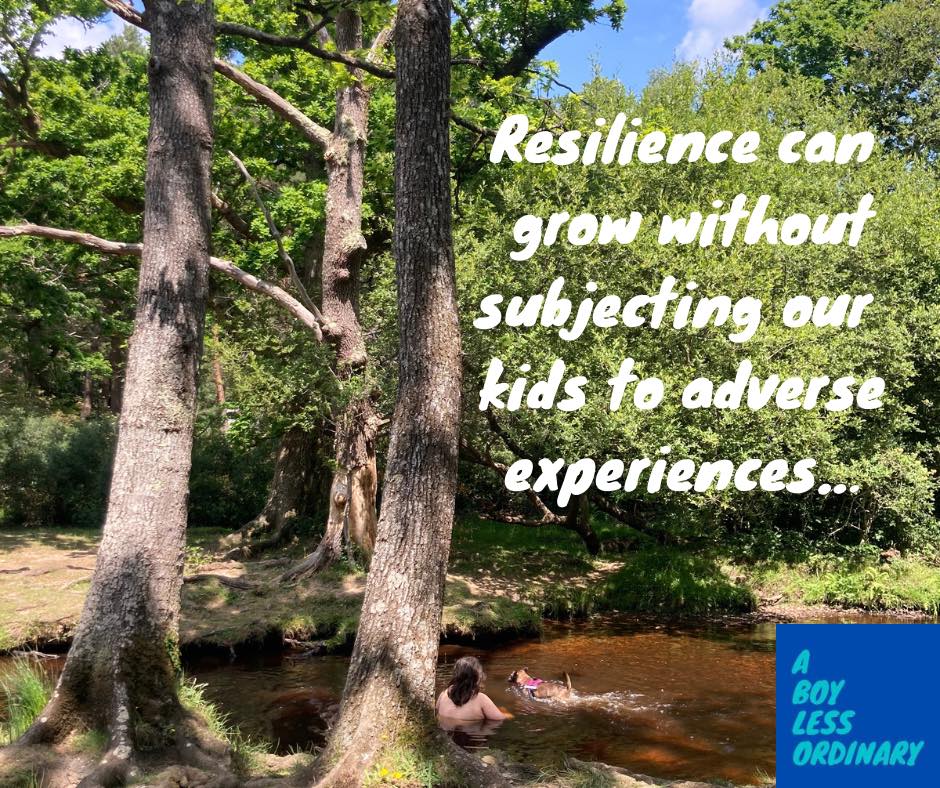
Think of it as a sum of their parts; as their confidence grows because they feel safe, and they learn to recognise their skills they will become stronger, more confident, more self-aware. This can and will happen without subjecting our kids to adverse experiences. I’m convinced of it.
 A Boy Less Ordinary